
Something is happening. There is a force stirring, shaking up the politics of our times. And it’s not the surge of nationalism, fake news and populism, I’m talking about. Not the trend of negative politics, pitting people against just about everything and for just about nothing, splitting up and alienating. No, there is a different kind of politics emerging. Unifying people in a positive demand. A demand for action.
Tell-me-what-democracy-looks-like?!
THIS-IS-WHAT-DEMOCRACY-LOOKS-LIKE!
This was just one of many protest songs and slogans characterizing yesterday’s (24th May) climate march in London, which made up one of over 2000 climate strikes, marches and protests across the globe, attended by some 1.5 million people. Yesterday’s climate strike was a massive event, with protests taking place simultaneously in cities, towns and schools in over 125 countries. But it was just one of many recurring events, together making up a sustained movement.
…
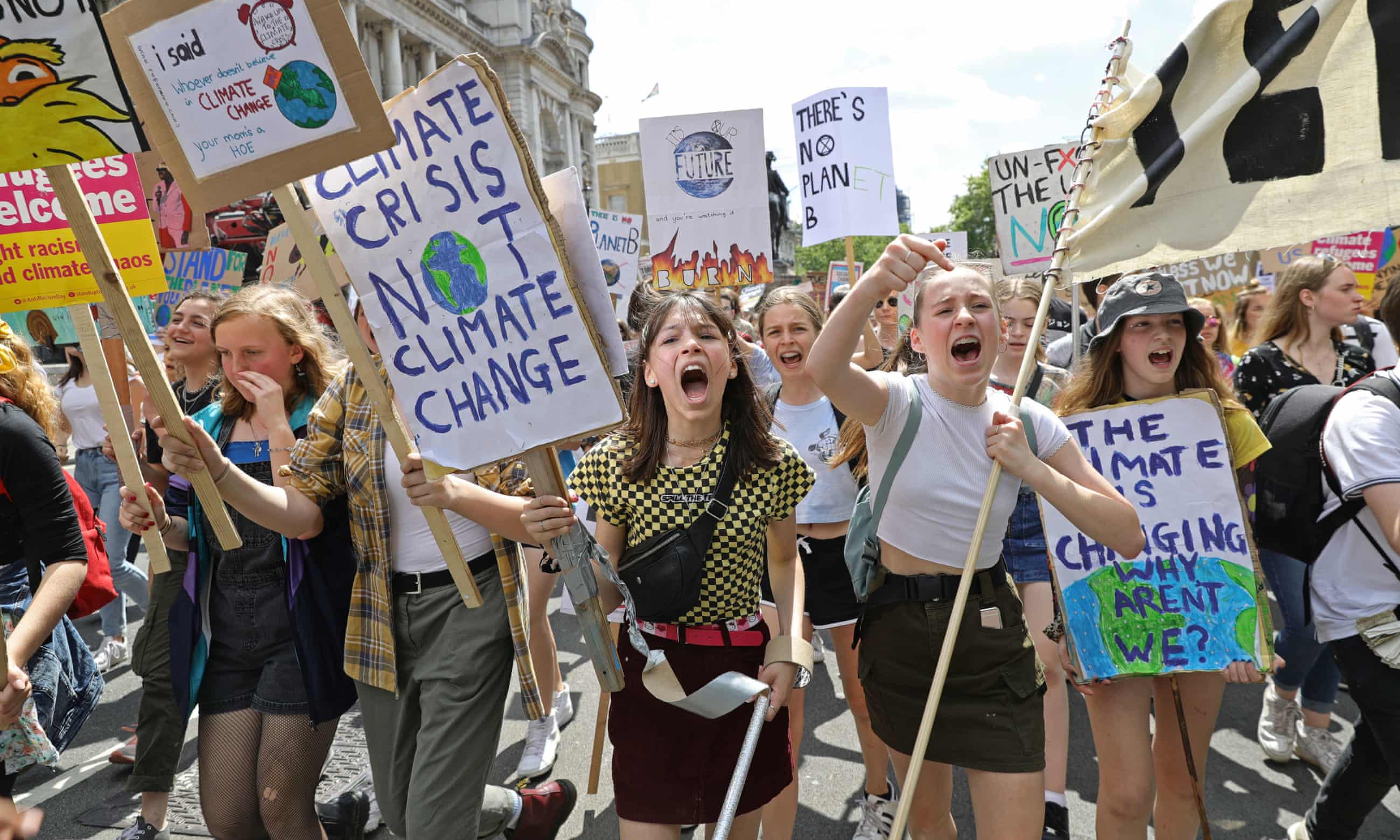
A movement started by school children, many of whom go on strike for the climate, for climate justice, for their (our) futures, every Friday. Friday’s for Future. “This is what democracy looks like” they sang out in the streets of London (and in streets of just about every city on earth, similar – I am sure – anthems rang out, in many different languages). It’s democracy of a global kind. To me it seems, this might just be what global citizenship looks like.

Friday’s for Future is a powerful phenomenon. Young people are mobilizing, lead by 16 year old Gretha Thunberg, who started a personal school strike for the climate in August 2018, in Sweden, which has grown into a movement. And it’s not just individual local school strikes. This has become a global movement, spilling into other spheres of society. Fridays for Future has given rise to Parents for Future, and there is a call for labour unions, working adults, pensioners – people everywhere – to join the next global strike in September.
…
Shortly after yesterday’s strikes, marches and protests, a group of prominent academics and activists (including Naomi Klein, Bill McKibben, Margaret Atwood, Noam Chomsky, Rebecca Solnit, Michael Mann) put out a statement supporting a call for people to “leave their offices, their farms, their factories” and join future strikes. Hoping:
that candidates will step off the campaign trail and football stars will leave the pitch; that movie actors will scrub off their makeup and teachers lay down their chalk; that cooks will close their restaurants and bring meals to protests; that pensioners too will break their daily routines and join together in sending the one message our leaders must hear: day by day, a business as usual approach is destroying the chance for a healthy, safe future on our planet.
This call is echoed among the students, parents and teachers of Fridays for Future, and by other activist groups supporting and joining the movement. There is a growing effort to mobilize not only schools but all sectors of the economy. There is something happening, and we haven’t seen the end of it.
What is so powerful about Friday’s for Future? To me, it was summed up in an image – a map (I am a geographer, after all). The map, showing all (registered) past, present and future protests across the world captures the sustained activities of a global movement. Local events made up of local people, who are all part of something bigger, connected across space and time. My first thought was – well, to explore the map in some detail – but my second thought, then, was: is this what global citizenship looks like?!
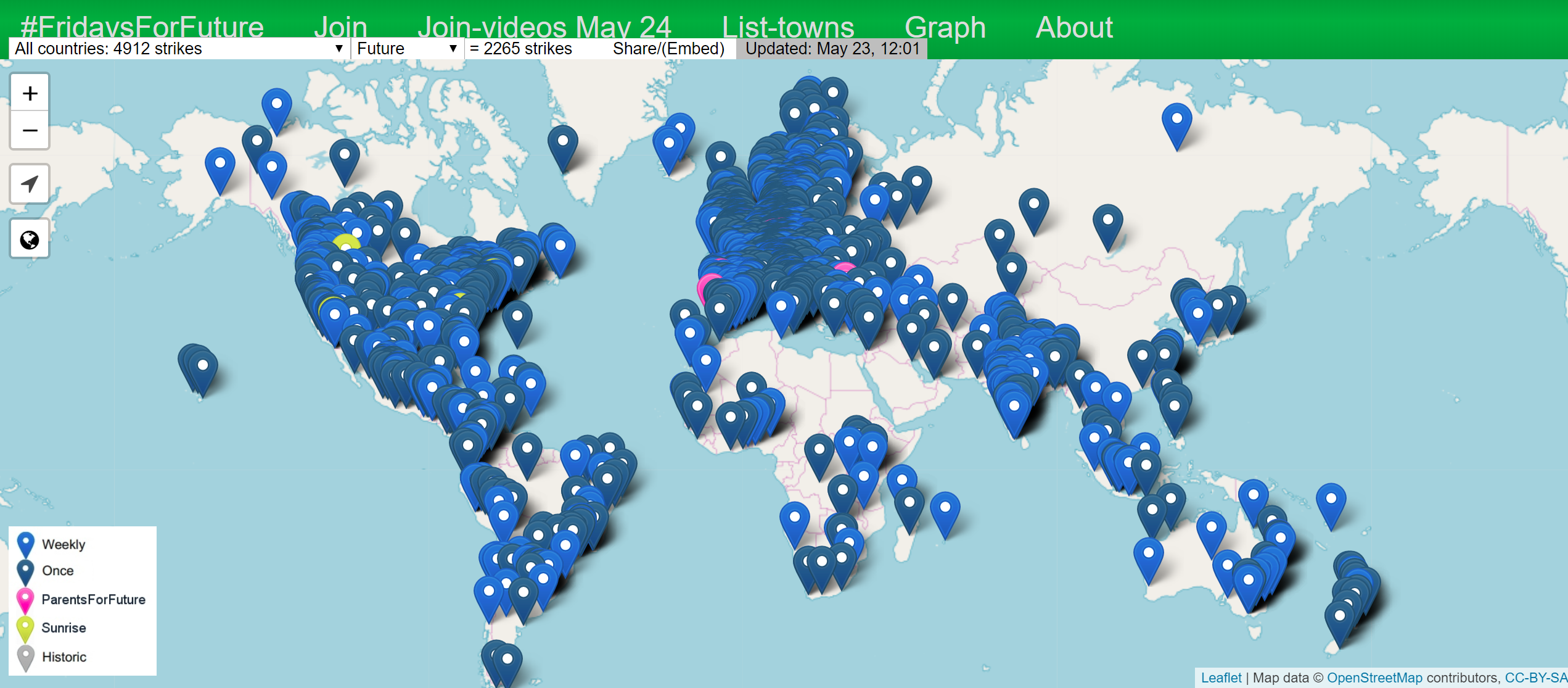
This map, to me, is a powerful image, an image of what global citizenship looks like, in action. Pins of various colors identify specific, local events, attended by local (or global) citizens, youths, parents; the colors represent the temporal nature of each event – weekly (regular, repeated), one-off past and future events; and the spread of pins, across the map of the world, documents the global reach and the links of one local event to local events everywhere, linking each and every one of them into a global politics. Making global citizens of local people, everywhere.
Of course, global citizenship as an idea is nothing new. Much has been said and written on the topic in recent decades (Delanty, Linklater, Dobson, Saiz, Barry, and many more), particularly in political theory and green political theory. The latter, in particular, has produced critical theories of global (ecological) citizenship based in a global solidarity with humans as well as the environment. Yet it seems to me that these have remained very much in the realm of ideas, abstract ideals for a sustainable utopia.
More commonly observable on the streets (or rather, in the airports) has been a ‘global citizen’ defined by his transnational affairs (rather than any global solidarity), defined by his friends, social networks and travels all being global, by his feeling at home in hotels from London to New York to Tokyo, and speaking English wherever he goes, as described by Falk (1993). A global citizen representing a denationalized global elite without any corresponding sense of (global) civic responsibility (Falk 1993). Fridays for Future maps a global citizenship of a different kind.
Now, as we witness the spread of nationalism and the push-back against trans-national collaboration – Brexit being the most obvious example – (very possibly a reaction against that kind of ‘global elite’ mentioned above), it may seem absurd to suggest that a there is a deeper sense of global citizenship stirring.
But then again… Something is happening. And we haven’t seen the end of it.
.
.
.
 Energy Ethics & Politics